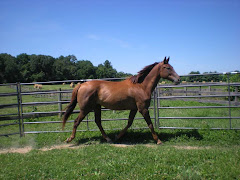
As it sometimes happens when you are working around horses, Meredith, one of our most faithful volunteers, got hurt a few weeks ago. She was helping to move round bales of hay into one of the fields for the horses when her foot was caught between a bale and a round bale holder, fracturing a bone. As a result, she had her leg in a cast up to the knee and was on crutches, making it really difficult for her to get around. Being a determined (and I must say tough) woman, Meredith has continued to help where she can at the rescue but she hasn’t been able to do much with her horse Beau for the past few weeks, so I have been playing with him.
Meredith’s horse, Beau, has been at the rescue since he was a youngster and he is now a big guy. While he is a friendly and people oriented horse who loves attention and treats, he is not very confident and can run right over you when he is scared. I learned that lesson first hand last summer and ended up momentarily directly underneath him after he knocked me to the ground. Fortunately I wasn’t hurt and the episode gave me so insight into how to behave around a horse with Beau’s lack of confidence.
The lack of confidence in a horse can manifest itself in a lot of ways. Being prey animals, horses are instinctively focused on their own safety and when pressured their first reaction may be, “I’m outa here!” An unconfident horse may throw its head up in the air, wring or violently swish its tail, snort, show white around it eyes and generally act agitated. But it may also simply freeze up and retreat inside of itself, going to its “happy place” to escape from pressure and then, finally when the pressure gets to be unbearable, explode into action, kicking or striking out. You will often hear people referring to an unconfident horse as either crazy or unpredictable.
Since Meredith has been out of action, I decided it would be a good time to see if I could help Beau become a little more confident. Beau’s personality or Horsenality™ in Parelli Natural Horsemanship™ lingo is “right brain”. What that means is that he tends to be more fear driven than dominant and he shows both ‘introvert’ (tense, hesitant, timid) and ‘extrovert’ (high headed, bracy, over-reactive) behaviors when you work with him.
When working with an unconfident horse, one of the most important things you can do to gain his confidence is to play the Friendly Game™. The goal of the Friendly Game™ is to build trust with the horse. Being prey animals, horses are naturally skeptical because in the wild, they can end up as someone’s lunch. We humans are predators and we often act like predators even when we don’t mean to. The Friendly Game™ is a way of demonstrating non-predatory behavior to the horse. By using rhythmic, repetitive motions and approach and retreat, we can help desensitize a horse to a lot of the thing that are just naturally scary.
I’d played the Friendly Game™ before with Beau by tossing a rope across his back and touching him all over. Beau is pretty good about being touched and doesn’t tense up when petted or rubbed with your hands but he doesn’t like anything being tossed at him and he isn’t too sure about the stick and string we use as a training tool. A good way to help a horse become more confident with something scary is to keep the scary object in front of you while leading the horse. Because the scary thing is moving away and the horse is following it rather than being chased by it, natural curiosity will eventually overcome fear and the horse will begin to approach and investigate. So I decided the best way to help Beau stop worrying about the stick and string was to lead him while I repeatedly beat the ground in front of me with the string. I had Beau on a 12 foot lead line and when I started walking while striking the ground with the string, almost all 12 feet played out of my hand before Beau began to walk behind me. I just kept walking and hitting the ground, not paying any attention to Beau who was dragging along behind me. After walking for a few minutes, I began to feel some slack in the rope, as Beau came up to investigate. When he did, I stopped walking but kept beating the rope on the ground. At first, it was had for Beau to stop and stand still, but eventually, he could stand quite close to me while I slapped the ground with the string.
Over our next few sessions, I played several versions of the Friendly Game™, tossing the lead line over Beau’s head, twirling the string above my head, beating the ground with the stick and pretty soon, Beau was standing quietly no matter what I did, soft eyed and head down. Then I decided to up the ante and introduce a plastic bag into the mix.
I’m not sure what it is about plastic bags but they can send a lot of animals into frenzy. I have a cat, one of my three live-in, household predators, who is absolutely terrified of plastic bags. When he was a kitten, he got himself tangled up with the string holding a mostly deflated Mylar balloon and found himself being chased around the house by a noisy “balloon monster”. To this day the sound of a plastic bag sends him scooting from the room. With horses, the problem may be more visual than sound driven but I have found that waving a white grocery bag around can send a lot of horses running for the hills.
When I pulled the plastic back out of my pocket and tied it to the end of my training stick, Beau immediately came to attention. Throwing his head up and snorting, he retreated to the end of his 12 foot lead line and then, wild-eyed, stood facing the bag. I know a little about horse body language but I didn’t have to be an expert to read his expression. It screamed, “OMG! What in the world is that and how can I get as far away as possible?”
Ignoring Beau’s obvious plastic bag angst, I turned away from him and waving the bag in front of me, started to walk. Snorting like a freight train, Beau dragged along behind me. I kept walking until the tension on the rope slackened just a bit and then I stopped walking, dropped the bag to the ground and waited. Beau eyes were riveted on the white plastic blob and he was beathing hard but he made no attempt to pull away and after a few minutes, he relaxed enough so that his head came down and he exhaled a big sigh of relief (I’m sure at not being eaten by that horse eating bag!). I praised Beau extravagantly and then picked the bag up and started again. After about 15 minutes, Beau was able to stand quietly at a distance of 3 or 4 feet from the frightening bag and I figured that he had about all he was going to take for his first grocery bag encounter so I stuffed the bag back into my pocket and fed him a treat. Eventually, I hope to be able to rub Beau all over his body with the bag without having him tense up. It may take a few more, horse-bag encounters but given the good progress he’s already made, I am sure Beau will get there in due time.
I’m really sorry that Meredith hurt her leg, but I have been having a good time playing with Beau. Mere is now in a walking cast and I’m sure she will be back in the saddle soon. I’m hoping that Beau’s adventures in bag land will give him a leg up in becoming a happier and more confident partner for her return.
Tuesday, May 4, 2010


Saturday, April 17, 2010
Wing and a Prayer
I saw a bald eagle on my way to the rescue this morning. It flew over the road in front of my car and I stopped to watch it soar away across a cornfield on its way to the Sassafras River. There is something so majestic, so undeniably fierce and free about an eagle that seeing one stops me dead in my tracks every time. A few years ago, on a winter vacation to Yellowstone National Park, I was fortunate enough to see a golden eagle dive on a duck and take it right out of the air in mid-flight. The sheer power of the bird took my breath away.
In fact, I have always been fascinated by birds of prey. Driven to the edge of extinction by the effects of DDT poisoning, hawks, osprey and eagles were a rare sight while I was going up. I read extensively about raptors and while I had no real interest in hunting, I often wondered what it would be like to train and fly a hawk or a falcon. So when I read recently about a school in Vermont that offers hands-on lessons with trained birds of prey, I jumped at the chance for this once in a lifetime experience.
The British School of Falconry is located in Manchester, Vermont and offers both introductory lessons and the opportunity to take a walk in the woods with an experienced handler and a pair of hawks. While the school has several kinds of raptors, their introductory lessons use Harris hawks. The Harris hawk is a medium sized bird of about 20 inches with a wing span of 3 to 4 feet. They are the only type of hawk known to hunt cooperatively in the wild and are favored by falconers because they are relatively social and easy to train.
My lesson was to start at 10 am on a relatively cool morning in April and we began in the hawk barn where I was given a large leather glove or gauntlet to protect my arm and hand from the hawk’s talons and introduced to the basics of handling the bird. The hawks wear jesses, a thin leather straps around their feet that are used for controlling the birds when they are perched on your arm. My instructor showed me how to hold the jesses between my thumb and forefinger, how to perch the bird on my arm and how to return the bird to a correct perching position if he tried to fly off while I was still holding on to the jesses. Once he felt like I had control of the bird, we went outside to a field that had high perches spaced across its length.
Training a hawk is very different from training a dog or a horse because a bird of prey does not form any kind of relationship with its handler like the horse or dog would. While food rewards can be used to reinforce training with a dog or horse, with a bird of prey, it is all about the food. My instructor explained that the hawks were weighed every day. A hawk will not hunt unless it is hungry. By trial and error during training, each hawk was found to have a particular weight at which it seemed to be most willing to cooperate with the handler. That was deemed to be its “flying weight”. When a hawk was at this flying weight it will be most eager to react when a bit of food is offered.
The bird my instructor handed to me was surprisingly light on my arm. With his jesses firmly grasped in my fist and holding my arm as level as possible, I carried him out into the field. When a falconer sends a hawk off on a hunt, he actually throws the bird to help it get up into flight. This is harder than it looks because you have to throw the bird up with your arm while releasing the jesses from your fist at the same moment, but I managed a credible first throw and my hawk flew off to one of the tall perches scattered around the field. I was feeling pretty pleased with myself as I listened to my instructor explain how I was going to get the bird back onto my arm. He gave me a small piece of meat and instructed me to hold it with the thumb of my gloved hand. Then he told me that when I was ready, to lift my arm up, holding it level from wrist to elbow. That would be the signal to the bird to fly back to my arm. He warned me that as the bird came back, I had to be careful not to flinch away so that the hawk could land.
I looked at the hawk sitting on the perch. He was about 100 yards from where I was standing and he didn’t seem to be the least bit interested in what we were doing. Not sure that I was going to be able to entice him back, I gripped the small piece of meat in my gloved hand and lifted my arm as instructed. The change in the bird was both immediate and startling. His head came around and he seemed to crouch down while fixing me with his piercing stare. Then he launched himself from the perch and flew straight at me. It was all I could do to hold myself still as this fairly impressive bird of prey bore down on me. As he got closer, he actually swooped down lower than my arm and then rotated his wings to slow himself and fly slightly upward toward my gloved hand. I was expecting to feel quite a jolt when he finally hit my arm but was surprised at how gently he landed and then took the small piece of meat from my hand. It was a thrill it but it also was a little bit intimidating, to have this fierce and wild bird flying directly at me.
After we had practiced for about half an hour and I had somewhat mastered the art of throwing the hawk correctly, we headed back to the barn and exchanged my initial hawk for another pair of birds for the hawk walk. We loaded these birds into travel crates and drove to a wooded area with a walking trail. We sent the hawks off and started down the trail. The hawks, flying free, sometimes flew ahead and sometimes followed along. It took some practice to keep and eye on where they were and at one point, the pair spotted a squirrel and were in the process of working together to corner it high in a tree. Since it wasn’t really hunting season and we weren’t hunting with the hawks, my instructor tried to call the birds back to us without much luck. The birds, intent on getting the squirrel, didn’t seem to be too interested in the little bits of meat we were offering. He finally had to resort to using a feathered lure which he swung around his head, to lure the hawks back to us. Watching the two hawks fly free in the woods and then having them return to us was exhilarating.
Studying Parelli™ Natural Horsemanship I have spent a lot of time learning about predators and prey animals. I even live with three small feline predators, perhaps the least domestic of any of the domesticated animals. But I have never had an experience that compared to holding that Harris hawk on my arm and watching it fly free in the forest. There was such a barely concealed ferocity about that hawk, a feeling that even with all of its training and handling, at any moment it could tap into its essential nature and return to the wild without a backward glance. It was like holding a spirit being on my fist. It just took my breath away.
In fact, I have always been fascinated by birds of prey. Driven to the edge of extinction by the effects of DDT poisoning, hawks, osprey and eagles were a rare sight while I was going up. I read extensively about raptors and while I had no real interest in hunting, I often wondered what it would be like to train and fly a hawk or a falcon. So when I read recently about a school in Vermont that offers hands-on lessons with trained birds of prey, I jumped at the chance for this once in a lifetime experience.
The British School of Falconry is located in Manchester, Vermont and offers both introductory lessons and the opportunity to take a walk in the woods with an experienced handler and a pair of hawks. While the school has several kinds of raptors, their introductory lessons use Harris hawks. The Harris hawk is a medium sized bird of about 20 inches with a wing span of 3 to 4 feet. They are the only type of hawk known to hunt cooperatively in the wild and are favored by falconers because they are relatively social and easy to train.
My lesson was to start at 10 am on a relatively cool morning in April and we began in the hawk barn where I was given a large leather glove or gauntlet to protect my arm and hand from the hawk’s talons and introduced to the basics of handling the bird. The hawks wear jesses, a thin leather straps around their feet that are used for controlling the birds when they are perched on your arm. My instructor showed me how to hold the jesses between my thumb and forefinger, how to perch the bird on my arm and how to return the bird to a correct perching position if he tried to fly off while I was still holding on to the jesses. Once he felt like I had control of the bird, we went outside to a field that had high perches spaced across its length.
Training a hawk is very different from training a dog or a horse because a bird of prey does not form any kind of relationship with its handler like the horse or dog would. While food rewards can be used to reinforce training with a dog or horse, with a bird of prey, it is all about the food. My instructor explained that the hawks were weighed every day. A hawk will not hunt unless it is hungry. By trial and error during training, each hawk was found to have a particular weight at which it seemed to be most willing to cooperate with the handler. That was deemed to be its “flying weight”. When a hawk was at this flying weight it will be most eager to react when a bit of food is offered.
The bird my instructor handed to me was surprisingly light on my arm. With his jesses firmly grasped in my fist and holding my arm as level as possible, I carried him out into the field. When a falconer sends a hawk off on a hunt, he actually throws the bird to help it get up into flight. This is harder than it looks because you have to throw the bird up with your arm while releasing the jesses from your fist at the same moment, but I managed a credible first throw and my hawk flew off to one of the tall perches scattered around the field. I was feeling pretty pleased with myself as I listened to my instructor explain how I was going to get the bird back onto my arm. He gave me a small piece of meat and instructed me to hold it with the thumb of my gloved hand. Then he told me that when I was ready, to lift my arm up, holding it level from wrist to elbow. That would be the signal to the bird to fly back to my arm. He warned me that as the bird came back, I had to be careful not to flinch away so that the hawk could land.
I looked at the hawk sitting on the perch. He was about 100 yards from where I was standing and he didn’t seem to be the least bit interested in what we were doing. Not sure that I was going to be able to entice him back, I gripped the small piece of meat in my gloved hand and lifted my arm as instructed. The change in the bird was both immediate and startling. His head came around and he seemed to crouch down while fixing me with his piercing stare. Then he launched himself from the perch and flew straight at me. It was all I could do to hold myself still as this fairly impressive bird of prey bore down on me. As he got closer, he actually swooped down lower than my arm and then rotated his wings to slow himself and fly slightly upward toward my gloved hand. I was expecting to feel quite a jolt when he finally hit my arm but was surprised at how gently he landed and then took the small piece of meat from my hand. It was a thrill it but it also was a little bit intimidating, to have this fierce and wild bird flying directly at me.
After we had practiced for about half an hour and I had somewhat mastered the art of throwing the hawk correctly, we headed back to the barn and exchanged my initial hawk for another pair of birds for the hawk walk. We loaded these birds into travel crates and drove to a wooded area with a walking trail. We sent the hawks off and started down the trail. The hawks, flying free, sometimes flew ahead and sometimes followed along. It took some practice to keep and eye on where they were and at one point, the pair spotted a squirrel and were in the process of working together to corner it high in a tree. Since it wasn’t really hunting season and we weren’t hunting with the hawks, my instructor tried to call the birds back to us without much luck. The birds, intent on getting the squirrel, didn’t seem to be too interested in the little bits of meat we were offering. He finally had to resort to using a feathered lure which he swung around his head, to lure the hawks back to us. Watching the two hawks fly free in the woods and then having them return to us was exhilarating.
Studying Parelli™ Natural Horsemanship I have spent a lot of time learning about predators and prey animals. I even live with three small feline predators, perhaps the least domestic of any of the domesticated animals. But I have never had an experience that compared to holding that Harris hawk on my arm and watching it fly free in the forest. There was such a barely concealed ferocity about that hawk, a feeling that even with all of its training and handling, at any moment it could tap into its essential nature and return to the wild without a backward glance. It was like holding a spirit being on my fist. It just took my breath away.
Friday, April 16, 2010
A Ride in the Snow
Winter came to Delaware in a big way this winter when a series of northeast storm buried much of the state under snow measuring in the double digit inches. There were many days I wasn’t able to go down to the rescue and Elena told me that the snow drifts in places were waist deep. The horses stuck pretty close to their run-in sheds and several mornings they had a breakfast of warm bran mash with apples.
Seeing all this snow got me thinking about the time I took a ride in the snow on my first horse, Max. You could say Max was my first rescue horse. I had just returned to Delaware after working for two year in Toledo, Ohio and I was looking for a horse. Max had been abandoned by his owner; a college coed who had brought him with her to the University of Delaware then met a boy, fell in love and stopped paying his board. He was being used as a lesson horse by the owners when I first came to the stable. I had asked my instructor to help me find a horse and she immediately suggested Max.
When I saw Max, it was love at first sight. Although Max was a registered appaloosa, he was 7/8s thoroughbred and he looked more like a racehorse than a cow pony. Solid chestnut in color except for a white snow flake pattern over his haunches, I thought he was the most beautiful horse I had ever seen. He was nine years old and had been professionally trained both in both English and western styles of riding. He could jump four foot fences and he had a smooth trot and rocking chair canter. When my instructor suggested him, I thought he was too good a horse for me. I was only looking for a pleasure horse and wasn’t an overly confident rider, but my instructor insisted that what Max really needed was an owner who would love him. So for the extravagant price of $1700 (a lot of money in 1981) which would reimburse the stable for the missed board payments, I became a horse owner for the first time.
In the beginning, Max didn’t have much of a personality. He seemed to go inside of himself whenever I went into his stall. But I loved him to distraction and spent hours with him, grooming him, feeding him carrots, hand grazing him on the lawn. Slowly but surely, his personality began to emerge. When he heard my voice, he would put his head out of his stall door and nicker to me. If I came to the pasture, he would amble to the fence looking for treats. Even though I was an inexperienced rider, he always gave me his best. Of course in 1981, I’d never heard of natural horsemanship. Looking back, I can see that Max showed all of the characteristics of a right brain introvert. He was compliant, timid and somewhat fearful. Sometimes he would seem to just go inside himself to get away from what was going on around him. Without knowing it; I had been playing the Friendly Game with him, which was, of course, exactly what he needed from me.
At the time, I knew nothing of lateral flexion or disengaging the hindquarters but it turned out that I needed those skills the first time I took Max for a ride in the snow. We don’t get significant snow in Delaware very often but that time there had been about 8 inches of snow and the pastures were white and inviting, unmarked by footprints as the horses had been in the barn. I saddled Max, led him to the largest pasture and mounted, looking forward to a quiet walk in the snow, but Max had other ideas. He’d been in his stall for almost two days and always was ready to move his feet. Max wanted to go. As he jigged and shook his head, I took a tighter hold of him and that was a mistake. Max took the bit in his teeth and started to run. The harder I pulled, the faster he went. The footing was slick and I was afraid that if I didn’t fall off, Max would slip and we would both go down. I didn’t know what to do, so I did the only thing I could think of. I bridged the reins, planted my hands on his neck and cranked his head around so he was circling to the right. He slowed as the circles got smaller and when he stopped, I threw myself out of the saddle. We stood there looking at each other, both breathing hard and shaking. Eventually I caught my breath and calmed down enough to lead him back to the indoor arena. I’d had enough of an outing for that day. Max and I were partners for 23 years after that first winter but I don’t think I ever had a ride that was quite that wild.
I’ve had my current horse, Sonny, for four years but we have never had a chance to go riding in the snow. Maybe sometime he and I can take a spin around the snowy fields, but first, I’d play with him on the ground, check his flexion and disengagement and see what horse shows up before I mount up and ride because I am getting a little to old to have my horse run off with me in the snow!
Seeing all this snow got me thinking about the time I took a ride in the snow on my first horse, Max. You could say Max was my first rescue horse. I had just returned to Delaware after working for two year in Toledo, Ohio and I was looking for a horse. Max had been abandoned by his owner; a college coed who had brought him with her to the University of Delaware then met a boy, fell in love and stopped paying his board. He was being used as a lesson horse by the owners when I first came to the stable. I had asked my instructor to help me find a horse and she immediately suggested Max.
When I saw Max, it was love at first sight. Although Max was a registered appaloosa, he was 7/8s thoroughbred and he looked more like a racehorse than a cow pony. Solid chestnut in color except for a white snow flake pattern over his haunches, I thought he was the most beautiful horse I had ever seen. He was nine years old and had been professionally trained both in both English and western styles of riding. He could jump four foot fences and he had a smooth trot and rocking chair canter. When my instructor suggested him, I thought he was too good a horse for me. I was only looking for a pleasure horse and wasn’t an overly confident rider, but my instructor insisted that what Max really needed was an owner who would love him. So for the extravagant price of $1700 (a lot of money in 1981) which would reimburse the stable for the missed board payments, I became a horse owner for the first time.
In the beginning, Max didn’t have much of a personality. He seemed to go inside of himself whenever I went into his stall. But I loved him to distraction and spent hours with him, grooming him, feeding him carrots, hand grazing him on the lawn. Slowly but surely, his personality began to emerge. When he heard my voice, he would put his head out of his stall door and nicker to me. If I came to the pasture, he would amble to the fence looking for treats. Even though I was an inexperienced rider, he always gave me his best. Of course in 1981, I’d never heard of natural horsemanship. Looking back, I can see that Max showed all of the characteristics of a right brain introvert. He was compliant, timid and somewhat fearful. Sometimes he would seem to just go inside himself to get away from what was going on around him. Without knowing it; I had been playing the Friendly Game with him, which was, of course, exactly what he needed from me.
At the time, I knew nothing of lateral flexion or disengaging the hindquarters but it turned out that I needed those skills the first time I took Max for a ride in the snow. We don’t get significant snow in Delaware very often but that time there had been about 8 inches of snow and the pastures were white and inviting, unmarked by footprints as the horses had been in the barn. I saddled Max, led him to the largest pasture and mounted, looking forward to a quiet walk in the snow, but Max had other ideas. He’d been in his stall for almost two days and always was ready to move his feet. Max wanted to go. As he jigged and shook his head, I took a tighter hold of him and that was a mistake. Max took the bit in his teeth and started to run. The harder I pulled, the faster he went. The footing was slick and I was afraid that if I didn’t fall off, Max would slip and we would both go down. I didn’t know what to do, so I did the only thing I could think of. I bridged the reins, planted my hands on his neck and cranked his head around so he was circling to the right. He slowed as the circles got smaller and when he stopped, I threw myself out of the saddle. We stood there looking at each other, both breathing hard and shaking. Eventually I caught my breath and calmed down enough to lead him back to the indoor arena. I’d had enough of an outing for that day. Max and I were partners for 23 years after that first winter but I don’t think I ever had a ride that was quite that wild.
I’ve had my current horse, Sonny, for four years but we have never had a chance to go riding in the snow. Maybe sometime he and I can take a spin around the snowy fields, but first, I’d play with him on the ground, check his flexion and disengagement and see what horse shows up before I mount up and ride because I am getting a little to old to have my horse run off with me in the snow!
A Lesson from the Herd
Despite our best efforts sometimes an adoption doesn’t work out. Because we want to find permanent loving homes for our horses, when that happens, our rescue allows the horse to be returned. Last year, that happened with Clarence.
Clarence was a black and white spotted draft horse that we bought to prevent him from being sold at auction. When we first met him, he was tied in a trailer, his head unnaturally high, halter snugged up to the trailer wall. He was so big that we were worried he wouldn’t fit in our trailer, but he loaded easily and didn’t fuss on the ride back to the farm.
Clarence’s personality was an interesting mix of left brain introvert and right brain extrovert. He was dominant in the field with other horses, particularly at feeding time and before long, most of the horses that shared his field were showing scars from encounters with Clarence. He was also pushy with the volunteers. I’m not easily intimidated but I must admit, when I first met this horse, his size and attitude worried me. Still, I knew the best thing was to begin playing the seven games with Clarence, using the driving game when he was being pushy and matching his energy to keep him focused. Soon, he was behaving more like a partner with the volunteers but he was still bullying his pasture mates.
Clarence’s large size and flashing coloration made him an attractive adoption prospect and before long our director though she had found a match with a family looking for a second horse. He behaved well when the family came to our farm to work with Clarence. They handled and rode him and soon he was on his way to his new home. Clarence’s new owners were well intentioned but unfortunately had not had much experience with such a dominant horse and soon, he was taking advantage of them, pushing them around like he had done with his pasture mates. When he aimed a kick at the grandmother, the family reluctantly decided he was too much horse for them and asked to return him. We agreed that would be the best course of action for all and so Clarence returned.
When Clarence left the farm, we observed a big change in behavior with his former pasture mates. Feeding time was much calmer and there were far fewer disputes. My own horse Sonny, who had shared the pasture with Clarence, had far fewer nicks and scratches, and I wasn’t anxious to have him share a pasture with Clarence again. So we decided to put Clarence in with the retirees when he returned.
Most of the horses in our retiree field are former race horses whose owners wanted them to live out the rest of their lives in comfort and freedom. The leader of the field is a chestnut thoroughbred gelding named Lord Don. Don won over $200,000 during his racing career and is a small horse with a big self concept. Friendly toward humans, the well named Lord Don rules his field with a regal attitude. He eats first and doesn’t put up with any nonsense within the herd. Despite his small stature, all of the other thoroughbreds defer to him and there is little conflict among the group.
It was into this mix that we released the returning Clarence. Full of self confidence, head high, stubby tail flagged out behind, Clarence trotted into the field toward the smaller horses. His jaunty attitude lasted only as long as it took for him to reach Don and soon, Clarence was running full tilt back toward the paddock with the smaller Don right on his heals, biting at his spotted butt. The clash didn’t last long but when it was over, it was clear to all of us that Clarence was not going to be the dominant horse in this field.
The change in Clarence’s behavior was remarkable. Not only was he no longer first to eat, he actually waited until all of the thoroughbreds were positioned at their buckets before he would come into the feeding paddock and even then he often had to be cajoled. Rather than nipping his pasture mates, Clarence was now the horse that had suffered this behavior and his formerly unblemished coat was marred with nicks and scratches. With the volunteers, he was more hesitant and required more reassurance and friendly game.
It was clear to us that the best situation for Clarence would be to find an owner with draft horse experience who would not be intimidated by this big horse and could provide a home with one or two pasture mates to minimize herd conflict. Fortunately, we received a call from a man in Virginia who fit that bill. Already the owner of a Belgium mare and looking for another draft horse to ride, this gentleman came to look at Clarence and feel in love. Soon Clarence was on his way to Virginia and this placement was a success. Recently, I received an e-mail update with pictures showing a healthy Clarence under saddle and his owner reports that he “is a total beefcake and head of the herd.”
Clarence was a black and white spotted draft horse that we bought to prevent him from being sold at auction. When we first met him, he was tied in a trailer, his head unnaturally high, halter snugged up to the trailer wall. He was so big that we were worried he wouldn’t fit in our trailer, but he loaded easily and didn’t fuss on the ride back to the farm.
Clarence’s personality was an interesting mix of left brain introvert and right brain extrovert. He was dominant in the field with other horses, particularly at feeding time and before long, most of the horses that shared his field were showing scars from encounters with Clarence. He was also pushy with the volunteers. I’m not easily intimidated but I must admit, when I first met this horse, his size and attitude worried me. Still, I knew the best thing was to begin playing the seven games with Clarence, using the driving game when he was being pushy and matching his energy to keep him focused. Soon, he was behaving more like a partner with the volunteers but he was still bullying his pasture mates.
Clarence’s large size and flashing coloration made him an attractive adoption prospect and before long our director though she had found a match with a family looking for a second horse. He behaved well when the family came to our farm to work with Clarence. They handled and rode him and soon he was on his way to his new home. Clarence’s new owners were well intentioned but unfortunately had not had much experience with such a dominant horse and soon, he was taking advantage of them, pushing them around like he had done with his pasture mates. When he aimed a kick at the grandmother, the family reluctantly decided he was too much horse for them and asked to return him. We agreed that would be the best course of action for all and so Clarence returned.
When Clarence left the farm, we observed a big change in behavior with his former pasture mates. Feeding time was much calmer and there were far fewer disputes. My own horse Sonny, who had shared the pasture with Clarence, had far fewer nicks and scratches, and I wasn’t anxious to have him share a pasture with Clarence again. So we decided to put Clarence in with the retirees when he returned.
Most of the horses in our retiree field are former race horses whose owners wanted them to live out the rest of their lives in comfort and freedom. The leader of the field is a chestnut thoroughbred gelding named Lord Don. Don won over $200,000 during his racing career and is a small horse with a big self concept. Friendly toward humans, the well named Lord Don rules his field with a regal attitude. He eats first and doesn’t put up with any nonsense within the herd. Despite his small stature, all of the other thoroughbreds defer to him and there is little conflict among the group.
It was into this mix that we released the returning Clarence. Full of self confidence, head high, stubby tail flagged out behind, Clarence trotted into the field toward the smaller horses. His jaunty attitude lasted only as long as it took for him to reach Don and soon, Clarence was running full tilt back toward the paddock with the smaller Don right on his heals, biting at his spotted butt. The clash didn’t last long but when it was over, it was clear to all of us that Clarence was not going to be the dominant horse in this field.
The change in Clarence’s behavior was remarkable. Not only was he no longer first to eat, he actually waited until all of the thoroughbreds were positioned at their buckets before he would come into the feeding paddock and even then he often had to be cajoled. Rather than nipping his pasture mates, Clarence was now the horse that had suffered this behavior and his formerly unblemished coat was marred with nicks and scratches. With the volunteers, he was more hesitant and required more reassurance and friendly game.
It was clear to us that the best situation for Clarence would be to find an owner with draft horse experience who would not be intimidated by this big horse and could provide a home with one or two pasture mates to minimize herd conflict. Fortunately, we received a call from a man in Virginia who fit that bill. Already the owner of a Belgium mare and looking for another draft horse to ride, this gentleman came to look at Clarence and feel in love. Soon Clarence was on his way to Virginia and this placement was a success. Recently, I received an e-mail update with pictures showing a healthy Clarence under saddle and his owner reports that he “is a total beefcake and head of the herd.”
Saving Jimmy N
We had a scare with one of our young horses this week. A little over a year ago, we got a pair of young thoroughbred horses from a local owner. One of them, a 5 year old named Encrypted, had a big ankle. We knew he wouldn’t be anything but a riding horse. The other one, Jimmy N, had no obvious physical problems other than being a bit underweight and the owner told us he had been turned out and was sound.
We put Jimmy in training and three times thought we had found him a permanent home but every time he went away, he would later turn up unsound and be returned. We couldn’t figure out what was wrong and finally took him up to the New Bolton veterinary clinic in Pennsylvania (where Barbaro was treated).
After doing a complete set of radiographs, they told us that Jimmy had multiple chips in both rear fetlocks; most likely from racing, and suspensory ligament issues and that he would never be sound enough for serious work. It would have been nice (and a lot less expensive for us) if the owner had given us this information when he gave us the horse, but that is the nature of being in the horse rescue business. Everyone wants to pass on their problems to you.
So Jimmy became came a pasture ornament for us. He is only 6 year old and he is a bit of a nudge to the older retirees. As a result, he is always getting himself beaten up because he can’t leave well enough alone and he seems to be accident prone. We are always patching up the latest bite or scratch. I can’t figure out how he gets some of the bumps and bruises that he gets. Still he is one of my favorite horses at the rescue. I’ve done a lot of ground work with him and he is a loveable sort, always looking for attention.
On Tuesday I got a text message from the director that Jimmy was down and she thought it was serious. He wouldn’t eat and although she was able to get him up, he could hardly walk. We called the vet out on Wednesday and Jimmy was in such obvious pain that it was really difficult to watch. Out treatment options are somewhat limited by the fact that Jimmy does not take well to being confined in a stall. He weaves, stall walks and throws himself against the walls. I guess after having been confined during his racing career, he developed a few phobias. Because we didn’t see what happened to cause the problem. It was difficult for the vet to diagnose it but it was clear that it was a serious problem with his back end. We decided to give him some pain medicine and tranquilizer and see if he would improve in a couple of days.
The director sent me a message on Thursday that he wasn’t looking much better so I went in on Friday fully expecting to have to put this horse down. That isn’t much fun, particularly with a young horse. Fortunately, by Friday, he was walking much better and was eating again. We think now what might have happened was that he took a fall and really aggravated the suspensory issues. There has been a lot of rain and our pastures are rain soaked and slippery. Hopefully he will continue to improve,
This entire episode really got me thinking about the thoroughbred racing industry. I have always loved to watch the horses run. I think the first time I want to the track I was 10 or 11 years old and some of my best memories involve horse races. Who could forget seeing Secretariat winning the Belmont? But the longer that I work at the horse rescue, the more I think that much of what happens to thoroughbreds when they are in training is really inhumane. Most of the thoroughbreds that we get have issues, both physical and psychological. And many of them come to us with hidden issues. It is as if the owners feel that if they are honest about the horse’s condition, we won’t take the horse so they hide the issues and we end up putting either the horse or the people working with the horse at risk.
The thoroughbreds we get have such great hearts. Jimmy, with all the issues of chips in his hind fetlocks, always tried his best when we were riding him. It is hard not to take these horses into your heart when their hearts are so big. A horse like Jimmy, without a sanctuary like ours, would not have much of a future. Even at our rescue, his options are limited. We have plenty of pasture, so having a few pasture ornaments is not much of an issue, but if his physical issues get worse and the medical bills start to pile up, our options are really reduced in being able to provide adequate care. The whole situation just breaks my heart. Hopefully he will continue to improve. Keep your fingers crossed for him.
We put Jimmy in training and three times thought we had found him a permanent home but every time he went away, he would later turn up unsound and be returned. We couldn’t figure out what was wrong and finally took him up to the New Bolton veterinary clinic in Pennsylvania (where Barbaro was treated).
After doing a complete set of radiographs, they told us that Jimmy had multiple chips in both rear fetlocks; most likely from racing, and suspensory ligament issues and that he would never be sound enough for serious work. It would have been nice (and a lot less expensive for us) if the owner had given us this information when he gave us the horse, but that is the nature of being in the horse rescue business. Everyone wants to pass on their problems to you.
So Jimmy became came a pasture ornament for us. He is only 6 year old and he is a bit of a nudge to the older retirees. As a result, he is always getting himself beaten up because he can’t leave well enough alone and he seems to be accident prone. We are always patching up the latest bite or scratch. I can’t figure out how he gets some of the bumps and bruises that he gets. Still he is one of my favorite horses at the rescue. I’ve done a lot of ground work with him and he is a loveable sort, always looking for attention.
On Tuesday I got a text message from the director that Jimmy was down and she thought it was serious. He wouldn’t eat and although she was able to get him up, he could hardly walk. We called the vet out on Wednesday and Jimmy was in such obvious pain that it was really difficult to watch. Out treatment options are somewhat limited by the fact that Jimmy does not take well to being confined in a stall. He weaves, stall walks and throws himself against the walls. I guess after having been confined during his racing career, he developed a few phobias. Because we didn’t see what happened to cause the problem. It was difficult for the vet to diagnose it but it was clear that it was a serious problem with his back end. We decided to give him some pain medicine and tranquilizer and see if he would improve in a couple of days.
The director sent me a message on Thursday that he wasn’t looking much better so I went in on Friday fully expecting to have to put this horse down. That isn’t much fun, particularly with a young horse. Fortunately, by Friday, he was walking much better and was eating again. We think now what might have happened was that he took a fall and really aggravated the suspensory issues. There has been a lot of rain and our pastures are rain soaked and slippery. Hopefully he will continue to improve,
This entire episode really got me thinking about the thoroughbred racing industry. I have always loved to watch the horses run. I think the first time I want to the track I was 10 or 11 years old and some of my best memories involve horse races. Who could forget seeing Secretariat winning the Belmont? But the longer that I work at the horse rescue, the more I think that much of what happens to thoroughbreds when they are in training is really inhumane. Most of the thoroughbreds that we get have issues, both physical and psychological. And many of them come to us with hidden issues. It is as if the owners feel that if they are honest about the horse’s condition, we won’t take the horse so they hide the issues and we end up putting either the horse or the people working with the horse at risk.
The thoroughbreds we get have such great hearts. Jimmy, with all the issues of chips in his hind fetlocks, always tried his best when we were riding him. It is hard not to take these horses into your heart when their hearts are so big. A horse like Jimmy, without a sanctuary like ours, would not have much of a future. Even at our rescue, his options are limited. We have plenty of pasture, so having a few pasture ornaments is not much of an issue, but if his physical issues get worse and the medical bills start to pile up, our options are really reduced in being able to provide adequate care. The whole situation just breaks my heart. Hopefully he will continue to improve. Keep your fingers crossed for him.
Sunday, April 4, 2010
Fixing What's Broken
There have been times during my Parelli journey with Sonny that we have been going down a path that I thought would be taking us in the proper direction but I found that Sonny was not responding as I had expected. While I seem to be pretty good at recognizing when something is not working, I have not always been that successful at correcting the problem. Turns out that I don’t always know just what is broken.
Recently I was fortunate to be able to attend a clinic with the 5-Star Parelli instructor Carol Coppinger. This was my second clinic with Carol and we were working on level 3-4 skills. I’d heard Carol tell more than one student that it is important when working with your horse through a puzzle not to make him feel like he’s wrong and I’ve found that she is one of those rare people who can coach you through a problem without having you feel like you have been completely wrong.
The first morning we were in the arena with our horses on line playing with a variety of obstacles. There were 10 students in the class and even though it was a fairly big indoor ring, between horses and obstacles, space was a bit tight. Midway through the session, Carol told us that we were going to begin working at liberty. One by one, we were to remove the halters while disengaging our horses and then have them stick to us and continue to play with the obstacles.
I thought that we were going to have absolute chaos, but one by one as the horses were released, they stuck to their leaders. Then Carol called my name. I untied Sonny’s halter and turned to disengage him so that he would be facing me but instead of following me he drifted away and soon was trotting around the arena.
“We have a loose horse.” Carol called out to the rest of the group. “Protect your herd of two when he comes near you and chase him away so he can find Noreen.”
Sonny trotted around for a few minutes before finally making his way back to me. Thinking this would be the end of his Houdini routine, I patted his neck and slipped him a treat before disengaging him we could start again but instead of following me he turned away and soon was at the far end of the arena trying to join up with one of the other horses. He was chased back to me again but just wouldn’t stay with me and we repeated this catch and run off routine again. None of the other horses seemed to be having a problem following their leaders and feeling more than a little embarrassed at the disruption Sonny and I were causing, I finally concluded I needed to put him back on line.
At this point Carol came over. “OK, let’s see if we can figure out what the problem” Carol said. “Let me see you disengage him.”
I backed Sonny away from me, then looked at his butt and wiggled the carrot stick. Sonny turned to face me but his response was a bit lackluster.
“Your “disengage” is broken.” Carol said. “Let’s see if we can fix that.”
Carol took Sonny’s lead line from my hand, walked over to him and gave him a pat on the neck. Rubbing his back with her hand and the carrot stick, she stood next to his midsection for a moment before taking a step straight backwards and focusing on his rear end. When Sonny failed to turn promptly she popped him on his butt with the carrot stick, causing him to jump around to face her, ears pricked forward and attention riveted. The look on his face was almost comical. I was sure he was thinking “Who IS this woman?” Carol repeated the procedure and by the third time, Sonny was turning immediately when she focused on his hindquarters. Then she shifted around to Sonny’s other side and replicated the process before handing back his lead line and letting me give it a try.
“OK” Carol said after watching me briefly, “I think we have that fixed.”
I silently hoped she was right as I unknotted Sonny’s halter and disengaged his hindquarters. He stuck to me for a few minutes but then one of the other horses trotted by and Sonny turned to follow. Desperately trying to disengage Sonny, I flicked the carrot stick toward him. He jumped sideways and dashed away. Deflated I looked toward Carol.
“That was too much for working at liberty,” she told me. “At liberty you need to be much more subtle. It looks to me like now your friendly game is broken. So go ahead and catch him and then we will fix that.”
By this time I was getting pretty dejected, but I retrieved Sonny and put his halter on. Carol told me to rub Sonny’s back along his right side with my hand and the carrot stick but he didn’t seem to want me behind his withers. At her instruction, I persisted until he relaxed and then went around to the left side. Pretty soon he let out a big sigh and was following me around meekly.
“OK”, I said to no one in particular, “Let’s give this one last try.” Removing Sonny’s halter for the third time, I disengaged him and walked off. To my great relief, Sonny followed along and this time stuck to me. Heaving a sigh, I smiled toward Carol.
Addressing the group Carol acknowledged my trials. “Noreen is doing the right thing here. When something is broken at liberty, you go back on line to fix it. Sometimes it will take you more than one attempt to get it right. You just have to keep working on it.”
The rest of the liberty session passed without Sonny taking another walk on the wild side and by the time we broke for lunch, I wasn’t feeling quite so embarrassed about our lack of harmony at liberty. Besides, I had learned an important lesson about what is broken when the “Stick to Me” game isn’t working,
Following the afternoon group session, we each had a private 15 minute session with Carol. Since we could work on anything we wanted in our private sessions, I chose to work on change of direction and figure eights on line at the trot. Sonny does these maneuvers but often he exhibits what I refer to as “snarky” behavior, pinning his ears and feigning a charge. I explained the situation to Carol.
“That is usually a sign of dominant behavior,” Carol told me. “You’re already moving backwards when you ask for a change in direction so he thinks he is driving you. How’s your snappy back up? Why don’t you show me that?”
I asked Sonny to back up and he sauntered back a few steps.
“Is that as snappy as it gets?” Carol asked.
I asked Sonny again, this time with significantly more flapping of stick and arms. He back up a little more quickly.
“Well, that took quite a bit more effort on your part than on his part” Carol said. “I think your snappy back up is broken. Let’s see if we can fix that.”
Taking Sonny’s lead, Carol asked him to back up. When he gave his usual lackadaisical response she popped him in the chest with the savvy string and Sonny scooted backwards a step or two. Pretty quickly she had him backing with alacrity as soon as she asked.
“OK, that looks pretty good” she finally said. “Now let’s take a look at the figure eight.”
Carol asked Sonny to circle at the trot and after a couple of laps, she back up and asked for a change in direction. Sonny responded the way he usually does, starting toward her with ears pinned. She sent him off in the other direction by popping him on the shoulder with the savvy string. Looking surprised, Sonny hopped away on the new path.
“You need to make it a game” she told me. “The game is, if you come at me like that, I’m going to reach out and tag you. Pretty soon he is going to figure it out.”
As Carol continued to ask Sonny to change direction, he began to shift his front end more quickly away from her. By the fifth try, his shoulder was out of reach of the savvy string and he was registering a much nicer attitude on my “snark-o-meter.”
“That looks pretty good” Carol said. “Why don’t you give it a try?”
I used the snappy back up to move Sonny away from me and then asked him to trot in a circle. When I began to walk backwards and ask for a change in direction, he pivoted through the turn and trotted off in the other way with only the mildest of complaint.
“Wow” I said to Carol. “I never would have figured that the problem with his change in direction was not having a good snappy back up.”
The next morning I put Sonny on the 22 foot line and took him into the arena. I practiced disengaging him in both directions and then did a few snappy back ups. I asked him to trot a figure out around two barrels and he stepped off quickly keeping his far ear pricked forward and his near ear rotated toward me. Feeling encouraged, I took off his halter to check his liberty and he stuck to me like a tick on a dog. He trotted next to me over a pole on the ground and wove through some small cones. I was thrilled with our progress in such a short period of time and reflected that it is amazing how much you can fix once you have figured out just what is broken.
Recently I was fortunate to be able to attend a clinic with the 5-Star Parelli instructor Carol Coppinger. This was my second clinic with Carol and we were working on level 3-4 skills. I’d heard Carol tell more than one student that it is important when working with your horse through a puzzle not to make him feel like he’s wrong and I’ve found that she is one of those rare people who can coach you through a problem without having you feel like you have been completely wrong.
The first morning we were in the arena with our horses on line playing with a variety of obstacles. There were 10 students in the class and even though it was a fairly big indoor ring, between horses and obstacles, space was a bit tight. Midway through the session, Carol told us that we were going to begin working at liberty. One by one, we were to remove the halters while disengaging our horses and then have them stick to us and continue to play with the obstacles.
I thought that we were going to have absolute chaos, but one by one as the horses were released, they stuck to their leaders. Then Carol called my name. I untied Sonny’s halter and turned to disengage him so that he would be facing me but instead of following me he drifted away and soon was trotting around the arena.
“We have a loose horse.” Carol called out to the rest of the group. “Protect your herd of two when he comes near you and chase him away so he can find Noreen.”
Sonny trotted around for a few minutes before finally making his way back to me. Thinking this would be the end of his Houdini routine, I patted his neck and slipped him a treat before disengaging him we could start again but instead of following me he turned away and soon was at the far end of the arena trying to join up with one of the other horses. He was chased back to me again but just wouldn’t stay with me and we repeated this catch and run off routine again. None of the other horses seemed to be having a problem following their leaders and feeling more than a little embarrassed at the disruption Sonny and I were causing, I finally concluded I needed to put him back on line.
At this point Carol came over. “OK, let’s see if we can figure out what the problem” Carol said. “Let me see you disengage him.”
I backed Sonny away from me, then looked at his butt and wiggled the carrot stick. Sonny turned to face me but his response was a bit lackluster.
“Your “disengage” is broken.” Carol said. “Let’s see if we can fix that.”
Carol took Sonny’s lead line from my hand, walked over to him and gave him a pat on the neck. Rubbing his back with her hand and the carrot stick, she stood next to his midsection for a moment before taking a step straight backwards and focusing on his rear end. When Sonny failed to turn promptly she popped him on his butt with the carrot stick, causing him to jump around to face her, ears pricked forward and attention riveted. The look on his face was almost comical. I was sure he was thinking “Who IS this woman?” Carol repeated the procedure and by the third time, Sonny was turning immediately when she focused on his hindquarters. Then she shifted around to Sonny’s other side and replicated the process before handing back his lead line and letting me give it a try.
“OK” Carol said after watching me briefly, “I think we have that fixed.”
I silently hoped she was right as I unknotted Sonny’s halter and disengaged his hindquarters. He stuck to me for a few minutes but then one of the other horses trotted by and Sonny turned to follow. Desperately trying to disengage Sonny, I flicked the carrot stick toward him. He jumped sideways and dashed away. Deflated I looked toward Carol.
“That was too much for working at liberty,” she told me. “At liberty you need to be much more subtle. It looks to me like now your friendly game is broken. So go ahead and catch him and then we will fix that.”
By this time I was getting pretty dejected, but I retrieved Sonny and put his halter on. Carol told me to rub Sonny’s back along his right side with my hand and the carrot stick but he didn’t seem to want me behind his withers. At her instruction, I persisted until he relaxed and then went around to the left side. Pretty soon he let out a big sigh and was following me around meekly.
“OK”, I said to no one in particular, “Let’s give this one last try.” Removing Sonny’s halter for the third time, I disengaged him and walked off. To my great relief, Sonny followed along and this time stuck to me. Heaving a sigh, I smiled toward Carol.
Addressing the group Carol acknowledged my trials. “Noreen is doing the right thing here. When something is broken at liberty, you go back on line to fix it. Sometimes it will take you more than one attempt to get it right. You just have to keep working on it.”
The rest of the liberty session passed without Sonny taking another walk on the wild side and by the time we broke for lunch, I wasn’t feeling quite so embarrassed about our lack of harmony at liberty. Besides, I had learned an important lesson about what is broken when the “Stick to Me” game isn’t working,
Following the afternoon group session, we each had a private 15 minute session with Carol. Since we could work on anything we wanted in our private sessions, I chose to work on change of direction and figure eights on line at the trot. Sonny does these maneuvers but often he exhibits what I refer to as “snarky” behavior, pinning his ears and feigning a charge. I explained the situation to Carol.
“That is usually a sign of dominant behavior,” Carol told me. “You’re already moving backwards when you ask for a change in direction so he thinks he is driving you. How’s your snappy back up? Why don’t you show me that?”
I asked Sonny to back up and he sauntered back a few steps.
“Is that as snappy as it gets?” Carol asked.
I asked Sonny again, this time with significantly more flapping of stick and arms. He back up a little more quickly.
“Well, that took quite a bit more effort on your part than on his part” Carol said. “I think your snappy back up is broken. Let’s see if we can fix that.”
Taking Sonny’s lead, Carol asked him to back up. When he gave his usual lackadaisical response she popped him in the chest with the savvy string and Sonny scooted backwards a step or two. Pretty quickly she had him backing with alacrity as soon as she asked.
“OK, that looks pretty good” she finally said. “Now let’s take a look at the figure eight.”
Carol asked Sonny to circle at the trot and after a couple of laps, she back up and asked for a change in direction. Sonny responded the way he usually does, starting toward her with ears pinned. She sent him off in the other direction by popping him on the shoulder with the savvy string. Looking surprised, Sonny hopped away on the new path.
“You need to make it a game” she told me. “The game is, if you come at me like that, I’m going to reach out and tag you. Pretty soon he is going to figure it out.”
As Carol continued to ask Sonny to change direction, he began to shift his front end more quickly away from her. By the fifth try, his shoulder was out of reach of the savvy string and he was registering a much nicer attitude on my “snark-o-meter.”
“That looks pretty good” Carol said. “Why don’t you give it a try?”
I used the snappy back up to move Sonny away from me and then asked him to trot in a circle. When I began to walk backwards and ask for a change in direction, he pivoted through the turn and trotted off in the other way with only the mildest of complaint.
“Wow” I said to Carol. “I never would have figured that the problem with his change in direction was not having a good snappy back up.”
The next morning I put Sonny on the 22 foot line and took him into the arena. I practiced disengaging him in both directions and then did a few snappy back ups. I asked him to trot a figure out around two barrels and he stepped off quickly keeping his far ear pricked forward and his near ear rotated toward me. Feeling encouraged, I took off his halter to check his liberty and he stuck to me like a tick on a dog. He trotted next to me over a pole on the ground and wove through some small cones. I was thrilled with our progress in such a short period of time and reflected that it is amazing how much you can fix once you have figured out just what is broken.
Sunday, March 28, 2010
The Little Things
After what seemed to me to be the longest winter I’ve ever lived through, spring has finally come to the rescue and I’ve realized once again that it is the little things that make Greener Pastures such an astonishing place for me.
When I arrive in the morning, I am greeted by our barn cat, Trixie, who is always ready for her breakfast. Trixie is a sweet little anima and feeding her is always the first chore of the day. A small, grey tabby cat, she is always willing to climb into a warm lap and be petted. I don’t think Trixie is much of a hunter though, since I often see mice scurrying around the feed barn. Or perhaps, well fed by the volunteers, she has established a fragile détente with the rodent population and has adopted a “live and let live” policy toward them. Whatever her motivation toward the mice, she will often curl up on top of the stacked hay and sleep once she has consumed her breakfast.
The recent stretch of warm weather has accelerated the grass and daily more new shoots are emerging turning the pastures from their winter tan into an emerald carpet. Everywhere I look I see trees with the fuzzy red crowns that herald the appearance of leaves and the air is soft with fresh earth scent of spring. I’m told that the fresh earth smell actually comes from bacteria that thrive in the damp soil of spring and if that is so, then I am grateful for those little creatures.
On Thursday, I heard the raspy, prehistoric croaks of our colony of great blue herons again filling the skies as they squabble over nest and mates. Quiet during most of the year, the herons become vocal during breeding season. They have returned to their rookery by the river and are frequently seen overhead as they travel between nests and the Sassafras in search of food.
Out of the corner of my eye, I caught a flash of movement and turned to see a fox running through the lane that separates our pastures. With his red tail trailing behind him like a flag, he ran as if being chased by some unseen marauder. I called “Tally Ho” after him and watched him disappear over the hill into the hay pasture.
The horses are all shedding their winter coats. It must be itchy for them because they lean into the curry comb when they are being brushed. I took a curry comb into one of the fields and even the hard to catch horses seemed happy for my attention. I brushed Cooper until April came and pushed him away. She closed her eyes and stretched her neck forward as I worked the loose hair from her coat. I think she would have purred if she could have managed it. After a few minutes, I felt a soft touch on my arm and turned to find In-The-Crease looking for attention. When Crease came to us last year, we could hardly catch her, and now here she was coming over to be brushed. I used the curry comb to loosen the mud and brushed her coat until it was beginning to shine.
The perennials in the healing garden are beginning to show signs of life. I like to bring Sonny out of his pasture and sit on the wall of the garden while he grazes on the new grass that is particularly lush right behind the gazebo. Like a kid in a candy store, he hardly knows what spot to choose first and I feel like I am giving him a big treat. Just one more of the little things that makes Greener Pastures so special!
When I arrive in the morning, I am greeted by our barn cat, Trixie, who is always ready for her breakfast. Trixie is a sweet little anima and feeding her is always the first chore of the day. A small, grey tabby cat, she is always willing to climb into a warm lap and be petted. I don’t think Trixie is much of a hunter though, since I often see mice scurrying around the feed barn. Or perhaps, well fed by the volunteers, she has established a fragile détente with the rodent population and has adopted a “live and let live” policy toward them. Whatever her motivation toward the mice, she will often curl up on top of the stacked hay and sleep once she has consumed her breakfast.
The recent stretch of warm weather has accelerated the grass and daily more new shoots are emerging turning the pastures from their winter tan into an emerald carpet. Everywhere I look I see trees with the fuzzy red crowns that herald the appearance of leaves and the air is soft with fresh earth scent of spring. I’m told that the fresh earth smell actually comes from bacteria that thrive in the damp soil of spring and if that is so, then I am grateful for those little creatures.
On Thursday, I heard the raspy, prehistoric croaks of our colony of great blue herons again filling the skies as they squabble over nest and mates. Quiet during most of the year, the herons become vocal during breeding season. They have returned to their rookery by the river and are frequently seen overhead as they travel between nests and the Sassafras in search of food.
Out of the corner of my eye, I caught a flash of movement and turned to see a fox running through the lane that separates our pastures. With his red tail trailing behind him like a flag, he ran as if being chased by some unseen marauder. I called “Tally Ho” after him and watched him disappear over the hill into the hay pasture.
The horses are all shedding their winter coats. It must be itchy for them because they lean into the curry comb when they are being brushed. I took a curry comb into one of the fields and even the hard to catch horses seemed happy for my attention. I brushed Cooper until April came and pushed him away. She closed her eyes and stretched her neck forward as I worked the loose hair from her coat. I think she would have purred if she could have managed it. After a few minutes, I felt a soft touch on my arm and turned to find In-The-Crease looking for attention. When Crease came to us last year, we could hardly catch her, and now here she was coming over to be brushed. I used the curry comb to loosen the mud and brushed her coat until it was beginning to shine.
The perennials in the healing garden are beginning to show signs of life. I like to bring Sonny out of his pasture and sit on the wall of the garden while he grazes on the new grass that is particularly lush right behind the gazebo. Like a kid in a candy store, he hardly knows what spot to choose first and I feel like I am giving him a big treat. Just one more of the little things that makes Greener Pastures so special!
Subscribe to:
Comments (Atom)